Cleaning and disinfecting aren't the same thing. Cleaning removes visible dirt, waste, and odor from a surface, but it doesn't always kill the bacteria, viruses, or fungal spores that can still be lurking there. Disinfecting is the extra step that takes care of germs—but it only works on a surface that's already clean, since dirt and organic debris block the disinfectant from reaching what's underneath.
Disinfecting is especially important during and after a period of quarantine or illness, when the risk of disease transmission is higher. Once one guinea pig gets sick, a cagemate has already been exposed—so cleaning and disinfecting along the way, not just once everyone's recovered, helps keep the illness from spreading further. The same goes between foster animals and before a cage goes into storage.
When to Disinfect
Routine cage cleaning doesn't require disinfection every time. It's most useful when there's a specific reason to reduce the risk of pathogen transmission, such as:
- After a quarantine period
- After a contagious illness
- Between foster animals
- When introducing a new animal to an established herd
- Before putting a cage back into use after extended storage
- Before surgery, when recommended by your veterinarian
- During recovery from open wounds or other conditions where reducing environmental contamination matters
If your guinea pig has a diagnosed infectious disease, ask your veterinarian whether additional environmental precautions are necessary—some pathogens call for specific disinfectants or procedures.
Recommended Products
Rescue and F10-SC are the most commonly used veterinary disinfectants for guinea pigs. Getting the full benefit of either one comes down to hitting the labeled dilution and contact time—a rushed wipe-down at the wrong ratio won't give you the protection the label promises. Always check the current product label before use, since manufacturers do update their formulations and claims.
Rescue™
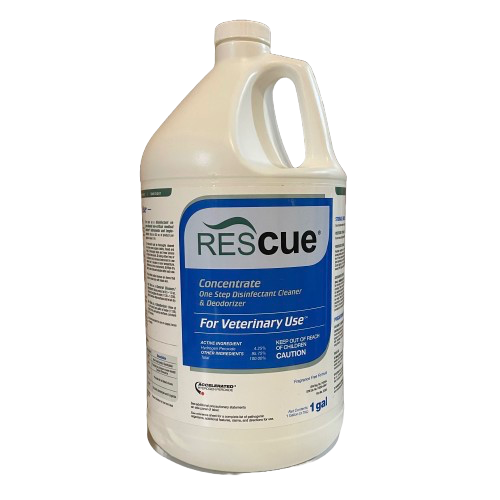
Rescue™ uses hydrogen peroxide as its active ingredient in an accelerated hydrogen peroxide (AHP) formula. The concentrate contains 4.25% hydrogen peroxide. At a 1:16 dilution, it has a 5-minute kill time for most bacteria, fungus and viruses. These kill times are supported by EPA-registered testing.
Rescue™ Label Claims
| Organism | Common Name | Relevant To | Dilution | Contact Time |
|---|---|---|---|---|
| Bordetella bronchiseptica | Kennel cough bacteria | Breathing problems, respiratory infections | 1:16 | 5 min |
| Streptococcus pneumoniae | Strep bacteria | Respiratory infections | 1:16 | 5 min |
| Klebsiella pneumoniae | Klebsiella | Respiratory infections, pneumonia | 1:16 | 5 min |
| Staphylococcus aureus | Staph bacteria | Bumblefoot, skin and wound infections | 1:16 | 5 min |
| Staphylococcus aureus (MRSA) | MRSA | Skin and wound infections | 1:16 | 5 min |
| Pseudomonas aeruginosa | Pseudomonas | Bumblefoot, wounds | 1:16 | 5 min |
| Salmonella enterica | Salmonella | Diarrhea, intestinal infections | 1:16 | 5 min |
| Escherichia coli | E. coli | Diarrhea, intestinal infections | 1:16 | 5 min |
| Listeria monocytogenes | Listeria | Listeria infection | 1:16 | 5 min |
| Trichophyton interdigitale | Ringworm fungus | Ringworm | 1:16 | 5 min |
| Microsporum canis | Ringworm fungus | Ringworm | 1:16 | 5 min |
Mixing Rescue™ Concentrate
| Bottle Size | Rescue Concentrate | Water |
|---|---|---|
| 12oz bottle | ¾ oz (about 1½ Tbsp) | Fill to 12 oz |
| 16oz bottle | 1 oz (2 Tbsp) | Fill to 16 oz |
| 32oz bottle | 2 oz (¼ cup) | Fill to 32 oz |
More info: Rescue Disinfectants
F10®SC
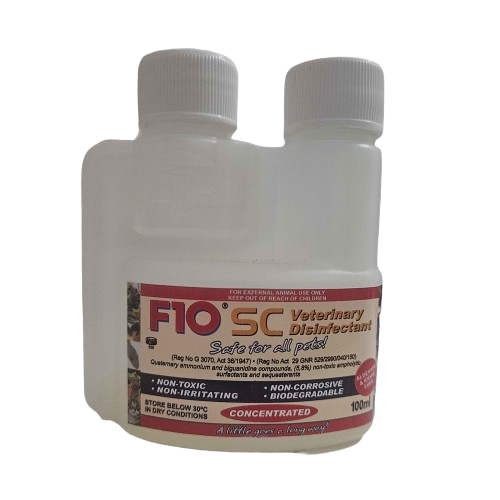
F10®SC uses quaternary ammonium compounds and biguanides as its active ingredients. The concentrate is a broad-spectrum disinfectant that's very effective against bacteria, fungus, and viruses. Testing also supports its effectiveness against protozoal oocysts, like Giardia, coccidia, and Cryptosporidium. F10 has been tested against specific organisms using established testing standards, with contact times and dilution rates varying by pathogen.
F10®SC Label Claims
| Organism | Common Name | Relevant To | Dilution | Contact Time |
|---|---|---|---|---|
| Pseudomonas aeruginosa | Pseudomonas | Bumblefoot, wounds | 1:250 | 15 min |
| Staphylococcus aureus | Staph bacteria | Bumblefoot, skin and wound infections | 1:250 | 15 min |
| Escherichia coli | E. coli | Diarrhea, intestinal infections | 1:250 | 15 min |
| Salmonella choleraesuis | Salmonella | Diarrhea, intestinal infections | 1:250 | 15 min |
| Clostridium difficile | C. diff | Severe diarrhea, intestinal inflammation | 1:250 | 15 min |
| Listeria monocytogenes | Listeria | Listeria infection | 1:250 | 15 min |
| Trichophyton mentagrophytes | Ringworm fungus | Ringworm | 1:250 | 15 min |
| Microsporum canis | Ringworm fungus | Ringworm | 1:250 | 15 min |
| Giardia spp. | Giardia | Diarrhea, intestinal infection | 1:100 | 60 min |
| Eimeria spp. | Coccidia | Diarrhea, intestinal infection | 1:100 | 60 min |
| Cystoisospora spp. | Coccidia | Diarrhea, intestinal infection | 1:100 | 60 min |
| Cryptosporidium spp. | Crypto | Diarrhea, intestinal infection | 1:100 | 60 min |
| Encephalitozoon cuniculi | E. cuniculi | Neurological and kidney problems | 1:100 | 60 min |
Mixing F10®SC Concentrate
| Bottle Size | F10SC 1:250 Concentrate | F10SC 1:100 Concentrate | Water |
|---|---|---|---|
| 12 oz bottle | 1.5 mL | 3.5 mL | Fill to 12 oz |
| 16 oz bottle | 2 mL | 5 mL | Fill to 16 oz |
| 32 oz bottle | 4 mL | 9.5 mL | Fill to 32 oz |
More info: F10 Products
Safety and Efficiency
Effective disinfection depends on both the correct dilution and the full contact time. The surface must remain visibly wet for the entire contact time, so reapply the disinfectant as needed if it begins to dry. Always clean away hay, bedding, feces, urine, and other debris before disinfecting, since organic material can reduce disinfectant effectiveness.
Both Rescue and F10-SC can be used without rinsing, but we do recommend rinsing food bowls and water bottles with clean water after disinfection. Disinfectants can be used on most hard, nonporous surfaces, including plastic, glass, stainless steel, sealed metal, and other materials that will not absorb the product. Porous materials such as untreated wood, unfinished fabric, cardboard, paper, and other absorbent materials are difficult or impossible to disinfect reliably because pathogens can penetrate the material.
Use disinfectants in a well-ventilated area and never mix disinfectants or other cleaning products. Keep concentrates safely away from guinea pigs and other animals, and allow treated surfaces to dry completely before returning guinea pigs to the area.
Always follow the most current product label or package insert. Dilution rates, contact times, rinsing requirements, approved surfaces, and label claims can change over time, so the manufacturer's current instructions should take priority.
Product Limitations
Neither Rescue nor F10-SC is labeled as a miticide. If your guinea pig has mites, treatment requires appropriate veterinary medication given to the animal; disinfecting the cage can help with general hygiene during treatment but does not replace veterinary treatment.
E. cuniculi is particularly difficult to eliminate from the environment because its spores are highly resistant to disinfectants. Research on E. cuniculi spores suggests that hydrogen peroxide-based disinfectants such as Rescue can inactivate them more quickly than quaternary ammonium-based disinfectants such as F10-SC, but complete inactivation in that research required substantially longer contact times than either product's standard directions. Environmental disinfection should therefore be considered one part of managing an E. cuniculi infection, not a guarantee that the environment has been completely decontaminated.
Always follow your veterinarian's recommendations when managing a contagious or difficult-to-eliminate infection. Keep disinfectants and concentrates out of reach of guinea pigs, and never return them to a freshly treated area until the product's instructions indicate that it is safe.
Steps to Disinfecting
Once your guinea pig has completed quarantine or recovered from an illness, give their enclosure a thorough cleaning and disinfection before returning them to it.
1. Strip Down the Enclosure
Discard all used bedding, hay, and other disposable materials from the quarantine enclosure. Do not reuse materials that may have been contaminated.
2. Clean Before Disinfecting
Wash the cage bottom, walls, and accessories with a 50/50 solution of distilled white vinegar and water to remove dirt, urine, feces, and other organic material. Consider cleaning items outside with soap and the garden hose, if available. Disinfectants work best on thoroughly cleaned surfaces and cannot reliably work through leftover debris.
3. Disinfect Thoroughly
Allow surfaces to dry if required by the product instructions, then apply the disinfectant at the correct dilution. Thoroughly wet the surfaces with disinfectant, and keep them visibly wet for the full contact time listed on the product label. Reapply disinfectant as needed if they begin to dry. Follow the product's instructions for rinsing and allow everything to dry completely before your guinea pig has access to the enclosure.
4. Replace What Cannot Be Disinfected
Fabric hideys, untreated wood, cardboard, and other porous accessories can trap pathogens where cleaning and disinfecting cannot reliably reach them. When dealing with a potentially contagious illness, replacing heavily contaminated porous items is often safer than trying to disinfect them.
5. Reset with Clean Supplies
Once everything is clean, disinfected, and completely dry, set up the enclosure with fresh bedding, hay, and other clean supplies. Do not return potentially contaminated materials to the enclosure after cleaning.